Arguable the most important process in nature, photosynthesis is the reason why every living thing on earth possesses the energy to survive. Understanding photosynthesis is key to understanding wider Biology, so I’ll try my best to explain it to you.
Light-Dependent Reaction
The equation for photosynthesis is: CO2 + H2O –> C6H12O6 (Glucose) + O2
So what do these letters and numbers mean? Well, CO2 can also be referred to as carbon dioxide, a colorless gas made of 1 carbon atom and 2 oxygen atoms, and H2O (2 hydrogen atoms + 1 oxygen atom) is what we call water! While these two products (the inputs) are the ones we write on paper, there is also one crucial piece we must address, sunlight.
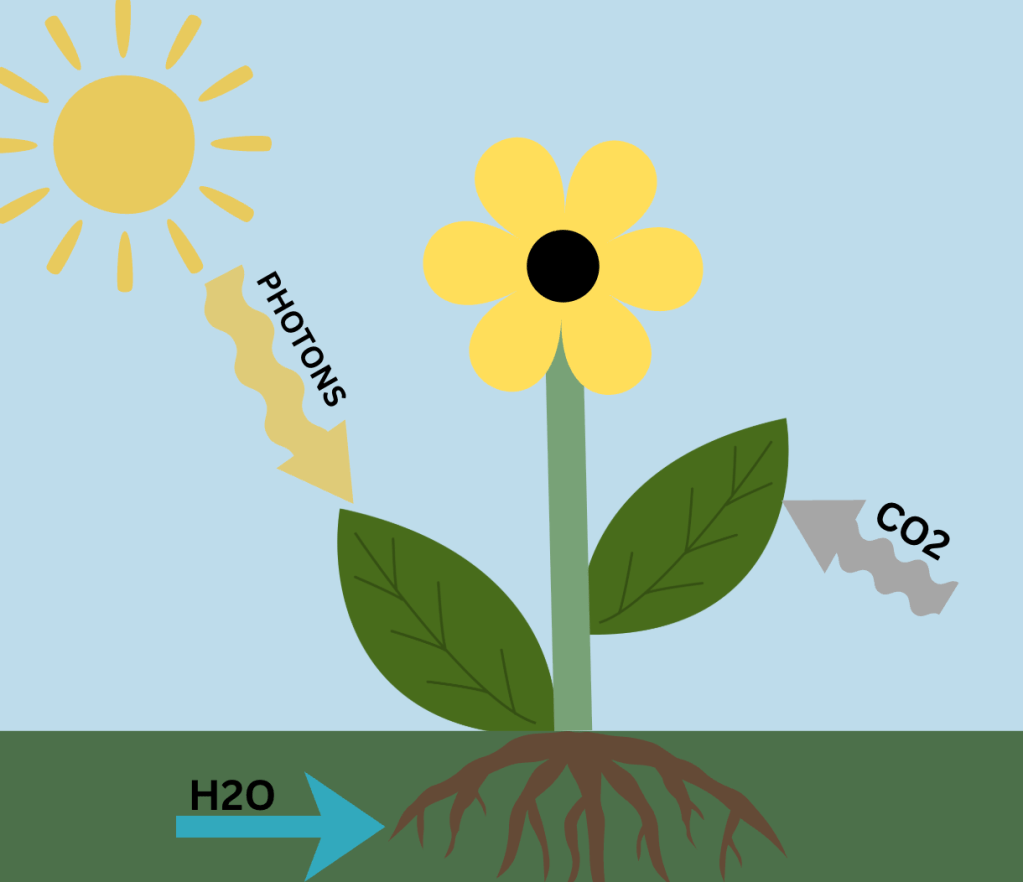
The Sun is the main source of all energy on earth. We can think of it as a “helper” in the process of photosynthesis, it does not give energy to the plant, but rather aids in creating it. The sun releases light energy to plants in the form of photons (light particles) which are then absorbed by the chlorophyll (a green pigment) in chloroplasts.
While water (H2O) is absorbed through the plant’s roots, carbon dioxide (CO2) enters via the stomata, minuscule pores on the plant’s leaves.
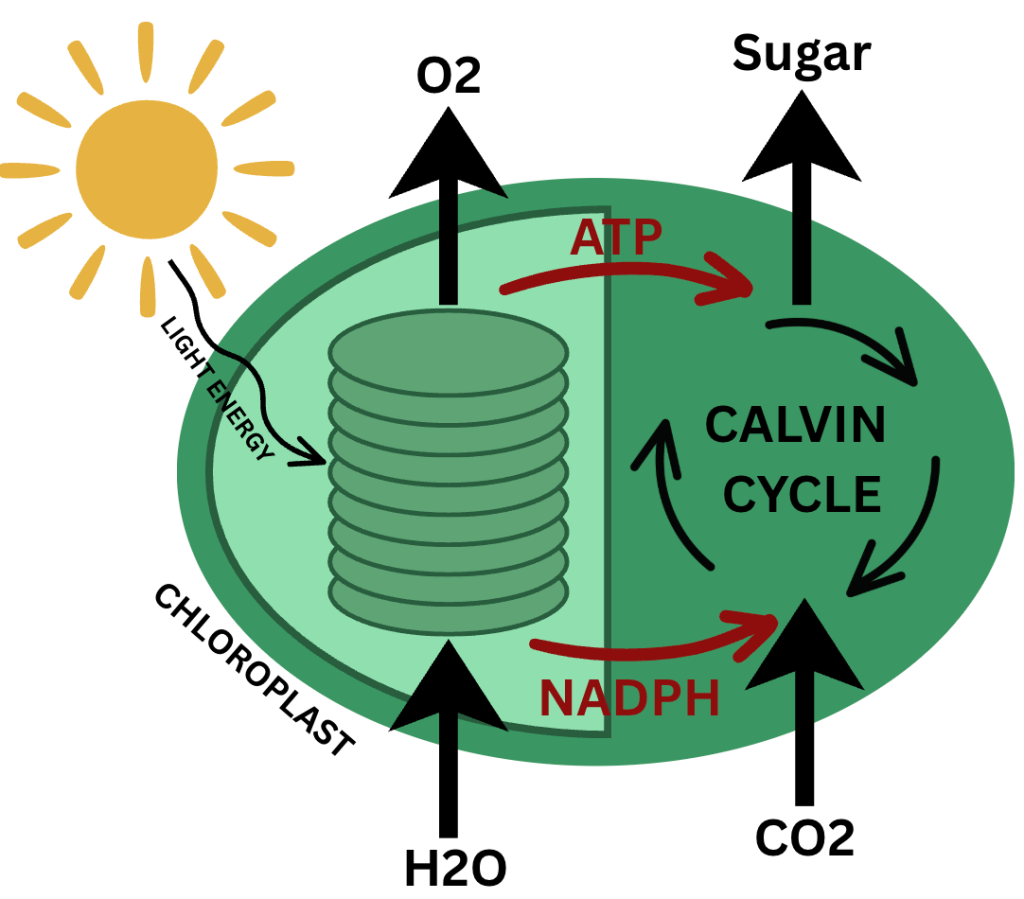
Photosynthesis takes place in the chloroplasts, organelles unique to plants. Inside the chloroplasts are multiple stacks of flat discs known as thylakoids. Light energy hits the thylakoid membrane, energizing the electrons to be passed down the electron transport chain. To replace the lost electrons, water (H2O) is split by a process initiated by the light energy, releasing oxygen, protons, and electrons. Oxygen diffuses into the atmosphere, and protons flow back across the membrane on an enzyme called ATP synthase, in turn powering the creation of ATP. The electrons, with the help of light energy, help create NADPH (an energy-carrying molecule) after passing through the ETC. These molecules are transported to the Calvin Cycle.
Light-Independent Reaction
The carbon dioxide and products of the light dependent reaction (ATP + NADPH) undergo a series of reactions in what’s known as the Calvin Cycle. The Calvin Cycle produces glucose (or sugar), wrapping up the process of Photosynthesis!
FEATURED POST

Why Is Taylor Swift So Popular?
Whether you love or hate her, Taylor Swift is one of the biggest names of our generation. But what makes her so popular? Why her? Early Career It’s important to know that Taylor started out as a country star; moving to Nashville at 13 to pursue her passion for music. Given her standout songwriting abilities…


 Mannsplained.
Leave a comment