Ever wonder what’s behind the brilliant story you see on the big screen? In this article I’ll break down the major elements of screenplays so you can start your creative journey! Your first step will be to find a screenwriting software that works for you, I use WriterDuet.
Formatting
BRIEF INTRODUCTIONS
There are four main parts of each scene of a screenplay. Sluglines (Yellow), introduction paragraphs (Grey), character dialogue (Violet), and action lines (Cyan).
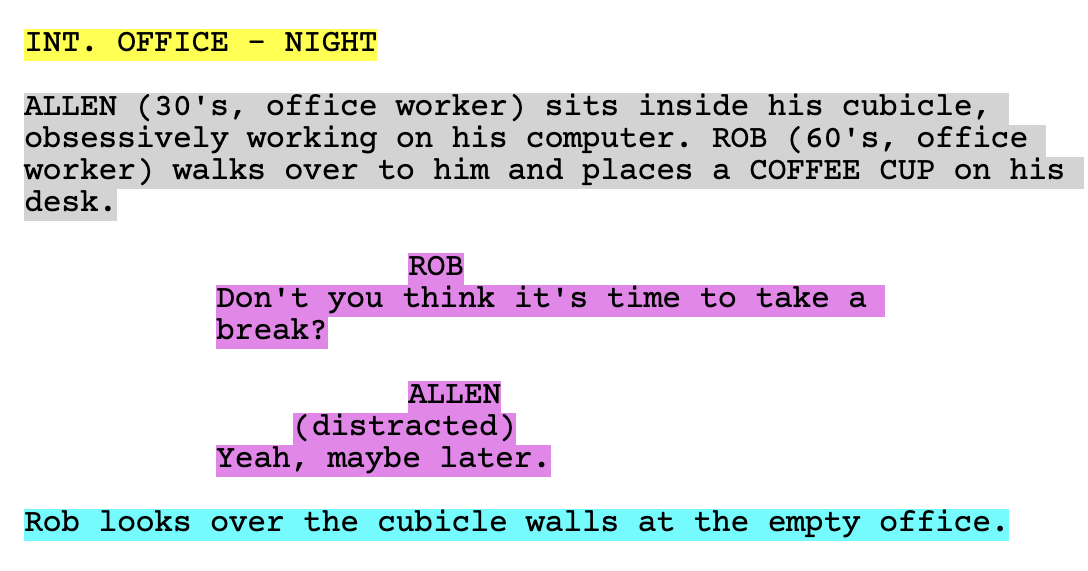
Sluglines provide a brief overview of where and when the scene takes place, they begin/head each new scene. Introduction paragraphs are the first action lines of your screenplay, they provide information about how the scene begins, and if necessary, character introductions as well. Character dialogue is simply who is saying what, parenthesis may be needed, but we’ll get into that later. Action lines provide context on the setting, name who is doing what, and label props used.
SPECIFICS

1. Sluglines (Yellow) must start with either INT. (Interior), or EXT. (Exterior) to determine whether the scene takes place inside or outside. You may use INT./EXT. for a scene which films in both at once, e.g. sitting in a car. Sluglines introduce the setting.
2. Characters (Violet) must be capitalized at the FIRST mention in a scene, another other mentions within the scene do not need to be capitalized.
3. Character descriptions (Cyan) come after the FIRST mention of a new character in the whole script. They tell the director information about the character relevant to the storyline.
4. Props (Red) must be capitalized at the FIRST mention in a scene.
5. Parenthesis (Green) is used sparingly in dialogue to inform the speech of a character. Do not use unless relevant to tone or actions, since many screenplays should leave room for actor/actress choice.
Story
There are five main elements of story in a screenplay. These are SETTING, CHARACTER, PLOT, CONFLICT, and THEME.
SETTING

Your setting should be established with a TIME and PLACE. In screenplays, this is shown through your sluglines at the beginning of each scene. After clarifying whether the scene is INT or EXT, you name a location (avoid using THE to begin, unless the location requires it, e.g. The White House). Finally, you’ll use a dash to clarify the time, this can be day, night, sunrise, evening, ext.
CHARACTER
The most important thing you need to know about your main characters, is that they each must have a WANT and a NEED.
WANT
Your characters wants are their conscious goals, what they actively try to pursue. An example may be an ex-convict, Wilson Arnold, wanting to get over his past by becoming an artist.
NEED
Your characters needs are the moral lessons they need to learn or inner dilemmas they need to overcome. For example, while Wilson may want to overcome his past, he needs to learn to accept it, instead of lying and trying to pretend it never happened.
In a story, we also have our PROTAGONIST and ANTAGONIST. Generally, we only have one protagonist, however antagonists can be much more flexible. Antagonists can be people, societies, nature, or even the character themself.
PROTAGONIST
Protagonists must actively move the story forward through their actions and choices. They must have a goal or motive that is constantly challenged by the antagonist.
ANTAGONIST
Antagonists actively or passively challenge the protagonist, throwing obstacles in their path to achieving their want, and building a storyline to help them achieve their need.
PLOT
There are four points to a plot: discovery, decision, conflict, and resolution.
DISCOVERY – The inciting incident. Good discoveries will pose questions and/or introduce stakes to inform the rest of the story.
DECISION – The choices your protagonist makes to achieve their wants, these will drive the plot forward and may lead to consequences.
CONFLICT – What is stopping your protagonist from achieving their goal. The story’s climax will be their greatest challenge.
RESOLUTION – Tying up unanswered questions, resolving conflicts. Should present a change in the protagonist, where their needs are met and they learn a moral lesson.
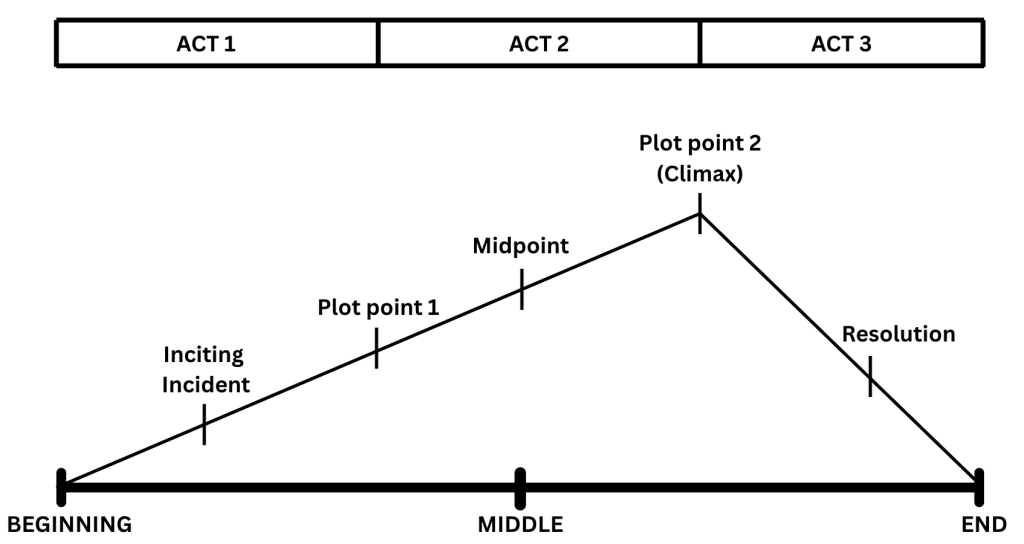
I strongly believe writers should have the freedom to stray from this structure and define their own unique stories but it’s always helpful to use this standard in building our plots.
CONFLICT
The conflicts of a story are the obstacles that prevent characters from achieving their goal. Some examples of conflicts can be:
Man vs. Man – Character challenged by another person (e.g. superheroes and villains).
Man vs. Society – Character challenged by their community/society they live in (e.g. conformity).
Man vs. Nature – Character challenged by natural forces (e.g. natural disasters).
Man vs. Self – Character challenged by their own inner conflict (e.g. insecurity).
Man vs. Fate – Character challenged by impending events (e.g. death row sentence).
Man vs. Technology – Character challenged by technology (e.g. killer robots).
THEME
Congratulations! You made it to the final element of storytelling in cinema, theme. A story’s theme is the central message it’s trying to convey. This can be a lesson, idea, truth, activism, ext. Themes are often deep, underlying messages that tie the story together, some of my favorites are:
Embracing passion – Dead Poets Society
Class inequality – Parasite
Empathy – To Kill a Mockingbird
Individualism vs. Conformity – One Flew Over the Cuckoo’s Nest
Wrapping things up
All in all, I hope you’ve learnt something from this lesson and maybe try writing your own screenplay sometime! Writing stories and building plots can be so fulfilling so I really recommend you see if it could be for you. Thank you for reading and that’s screenwriting, Mannsplained.
FEATURED POST
Why Is Taylor Swift So Popular?
Whether you love or hate her, Taylor Swift is one of the biggest names of our generation. But what makes her so popular? Why her? Early Career It’s important to know that Taylor started out as a country star; moving to Nashville at 13 to pursue her passion for music. Given her standout songwriting abilities…

 Mannsplained.
Leave a comment